SEO is one of the most important ways for businesses to improve their online visibility and reach potential customers through search engines. However, not every business needs to follow the same SEO strategy. What works for an online store may not work for a software company, healthcare business, real estate company, or local service provider.
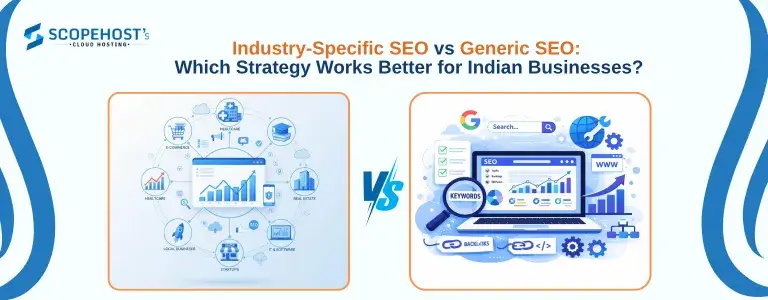
This is where the difference between industry-specific SEO and generic SEO becomes important. Generic SEO focuses on common optimization practices that can be applied to almost any website, while industry-specific SEO considers the unique needs, customers, competition, and search behavior of a particular industry.
For Indian businesses, choosing the right approach can make a significant difference. A strategy that understands the Indian market, target audience, location, and industry can often be more relevant than using the same SEO approach for every type of business.
In this article, we will explain the difference between industry-specific and generic SEO and help you understand which approach may work better for your business.
What Is Generic SEO?
Generic SEO refers to common SEO practices that can be used across different types of websites. These practices usually focus on improving a website’s visibility, content, structure, and overall search performance.
Some common examples include keyword research, creating useful content, improving page titles, optimizing website structure, adding internal links, improving page speed, and making websites mobile-friendly.
These are important for almost every website. Whether you run a small business, an online store, or a large company, these basic SEO practices can provide a strong foundation.
However, generic SEO does not always consider the specific requirements of a particular industry or audience. This can limit its effectiveness when a business operates in a highly competitive or specialized market.
What Is Industry-Specific SEO?
Industry-specific SEO takes the basic principles of SEO and adapts them to a particular business sector. Instead of using the same strategy for every business, it considers how customers in a specific industry search for information, products, and services.
For example, an SEO strategy for a real estate company may focus on property searches, locations, buying guides, and local terms. A healthcare website may need to focus on trustworthy information and clear explanations. A software company may focus on product features, comparisons, solutions, and business-related searches.
The goal is to understand what matters most in that particular industry and create an SEO strategy around it.

Why Industry Matters in SEO
Different industries have different customers, buying processes, competition, and search behavior. This means the keywords and content that work for one industry may not work well for another.
Consider a person searching for a restaurant compared with a company looking for business software. Their search behavior is completely different.
A restaurant customer may search for “restaurants near me,” while a business buyer may search for “CRM software for small businesses.” The search intent, decision-making process, and type of content required are different.
Industry-Specific SEO Understands Customer Intent Better
Search intent refers to the reason behind a person’s search. Understanding this is important because people at different stages of the buying process use different types of searches.
For example, someone who searches for “what is cloud hosting” may simply be researching the topic. Someone searching for “best cloud hosting provider for business” is likely much closer to making a decision.
An industry-focused SEO strategy can identify these different types of searches and create content for each stage.
Generic SEO Can Still Be Useful
Although industry-specific SEO has several advantages, generic SEO should not be ignored. Basic SEO practices provide the foundation that every website needs.
A website still needs clear page titles, useful content, good navigation, mobile-friendly pages, fast loading times, and a structure that search engines can understand.
These fundamentals are important regardless of the industry.
The difference is that industry-specific SEO builds on this foundation and adds strategies that are more closely connected to the business, its customers, and its market.
In other words, generic SEO provides the foundation, while industry-specific SEO helps customize the strategy.
Understanding the Indian Market
For SEO for Indian businesses, understanding the local market can be especially important. India has a diverse audience with different languages, locations, industries, purchasing habits, and levels of digital adoption.
A business targeting customers in Bengaluru may not use exactly the same SEO approach as a business targeting customers in Mumbai, Delhi, Chennai, or smaller cities.
Search behavior can also vary depending on the audience and location. Some businesses may need to focus heavily on local searches, while others may target customers across India or internationally.
An SEO strategy that considers these differences can help businesses target their audience more effectively.

Local SEO and Industry-Specific SEO
Local SEO can be an important part of industry-specific SEO for businesses that serve customers in specific locations.
For example, a dental clinic, restaurant, real estate agency, salon, or repair service may benefit from appearing for searches related to its city or local area.
A business targeting local customers can create useful location-based content, maintain accurate business information, and optimize its website around relevant local searches.
However, local SEO is not limited to adding city names to webpages. The content should still be useful and relevant to people in that particular location.
Industry-Specific Keywords Can Bring Better Traffic
One of the biggest advantages of an industry-specific SEO strategy is the ability to focus on keywords that are closely related to the products or services a business provides.
Generic keywords may have high search volume, but they do not always bring valuable visitors.
For example, a company selling enterprise software may receive traffic from a broad keyword such as “software.” However, visitors searching for “enterprise project management software” are much more closely connected to the company’s target market.
This does not mean businesses should completely avoid broad keywords. Instead, they should balance broad topics with specific searches that indicate stronger interest.
Content Can Be More Relevant
Industry-specific SEO also allows businesses to create content that directly addresses the questions and concerns of their target audience.
For example, a financial services company could create content about financial planning, business finance, or investment-related topics relevant to its customers. A technology company could publish guides about software, hosting, cybersecurity, or other topics related to its products.
This type of content can help a business demonstrate knowledge of its industry while attracting people who are actively searching for relevant information.
Industry-Specific SEO Can Help Build Authority
People are more likely to trust businesses that demonstrate a clear understanding of their industry.
Publishing useful and accurate content around topics related to your products and services can help establish your website as a valuable resource.
For example, a company specializing in cloud hosting can publish useful guides about server management, website performance, hosting options, and related topics.
Over time, consistently creating useful content around a particular subject can help strengthen the website’s topical relevance.
This does not happen overnight, but it can become a valuable part of a long-term SEO strategy.
Generic SEO May Not Be Enough in Competitive Industries
Some industries have extremely strong competition in search results. Simply following basic SEO practices may not be enough to stand out.
In competitive industries, businesses need to understand what their customers are searching for, what competitors are offering, and what types of content are already ranking.
An industry-specific SEO strategy can help identify opportunities that a general SEO approach might overlook.
Instead of trying to rank for every possible keyword, businesses can focus on specific topics and searches where they have relevant products, services, experience, or expertise.

Which Strategy Is Better?
The answer is not necessarily one or the other.
For most businesses, the strongest approach is to combine both.
Generic SEO provides the basic foundation. It ensures that your website is technically sound, easy to navigate, mobile-friendly, and optimized for search engines.
Industry-specific SEO then builds on that foundation by focusing on the audience, keywords, content, competition, and search behavior specific to your industry.
This combination allows businesses to maintain good SEO fundamentals while creating a strategy that is more relevant to their actual market.
How Indian Businesses Can Build an Industry-Specific SEO Strategy
The first step is to understand your target customer. Identify who they are, what problems they are trying to solve, and what they are likely to search for online.
Next, research keywords related to your products and services. Look beyond broad keywords and identify specific searches that show a strong connection to your business.
After that, create useful service pages and supporting content around these topics. Make sure your website clearly explains what you offer and why it is relevant to your target customers.
If your business serves specific cities or regions, include local SEO in your strategy where appropriate. Finally, monitor your results and improve your content based on what you learn.
This approach can make SEO for Indian businesses more focused and useful.
Common Mistakes to Avoid
One common mistake is using exactly the same SEO strategy as every other business. Even though many SEO fundamentals are universal, each industry has different customers and competitors.
Another mistake is focusing entirely on search volume. A keyword with thousands of searches may not bring valuable customers, while a more specific keyword with fewer searches may generate better leads.
Businesses should also avoid creating large amounts of low-quality content simply to target more keywords. It is better to create fewer pages that provide genuine value.
Finally, avoid creating location pages or industry pages that contain almost identical content. Each page should have a clear purpose and provide something useful to visitors.
How to Choose the Right Approach
If your business operates in a broad and relatively simple market, a strong generic SEO foundation may be enough to get started.
However, if you operate in a competitive, specialized, or location-focused industry, an industry-specific SEO strategy can provide a stronger direction.
Think about your customers and your market. If their needs, questions, and search behavior are very specific, your SEO strategy should reflect that.
The more specific your market is, the more valuable it can be to create content and optimization strategies specifically for that market.
Final Thoughts
Both generic SEO and industry-specific SEO have an important role to play. Generic SEO provides the essential foundation that every website needs, while industry-specific SEO allows businesses to build a strategy around their particular customers, products, services, and market.
For Indian businesses, this distinction can be particularly important because the market is diverse and highly competitive. Businesses may need to consider different cities, audiences, industries, and search behaviors when developing their SEO strategy.
Instead of choosing between generic SEO and industry-specific SEO, businesses can combine both approaches. Start with strong SEO fundamentals and then customize your strategy around your industry and target audience.
The goal should not simply be to attract more visitors. The goal is to attract the right visitors who are genuinely interested in what your business offers.
A focused SEO strategy can help your website reach those people, build stronger online visibility, and create better opportunities for long-term business growth.