Introduction: Hosting Meets Artificial Intelligence
Artificial Intelligence (AI) is now at the forefront of business—from personalized shopping experiences to predictive healthcare and financial automation—whatever the use, each of these intelligent applications needs more than just hosting, it needs AI-ready hosting infrastructure; AI workloads must have environments with the right computing power and flexibility for training, processing data, and scaling in real-time.
Standard web hosting wasn’t built for the purpose AI computing requires. The future includes advanced environments such as GPU cloud hosting or dedicated AI servers, and hybrid data center solutions, which support resource-intensive processes and complex workloads.

Core Infrastructure Requirements for AI Hosting
To provide the best performance, an AI hosting environment requires several essential needs
- A high compute environment to train machine learning and deep learning models, usually using expensive GPU or TPU servers.
- A fast, scalable storage solution for the large datasets used for AI training and inferencing. The best are NVMe SSDs and object storage, such as S3.
- High-bandwidth networking is necessary to transfer data easily across nodes and applications, especially when training on a distributed basis.
- Compatibility with AI frameworks for model development and deployment, including TensorFlow, PyTorch, and Scikit-learn.
In summary, AI hosting does not aim for traditional uptime, but performance, speed, and scalability
Key Technologies Powering AI Workloads
AI infrastructure is made up of a few specific technologies. The first is the hosting powered by the GPU. Unlike the CPU, the GPU is built to run thousands of operations simultaneously. So, the result is that the model training can be run faster; sometimes the model can be trained hours, and sometimes days quicker. GPU hosting programs like the NVIDIA A100 and Google TPUs are better for deep-learning tasks.
The second technology is containerization in Docker, and orchestration in Kubernetes. With containerization and orchestration, the entire AI environments can be portable and identical, and this holds true whether it is in the cloud, on-premise, or across a multitude of regions.
Another important aspect of AI infrastructure is distributed storage and fast data pipelining. Distributed storage applications like Ceph or Amazon S3 give a level of high throughput without interrupting the training cycles.
Together these technologies provide a scalable and intelligent hosting environment for any AI project.
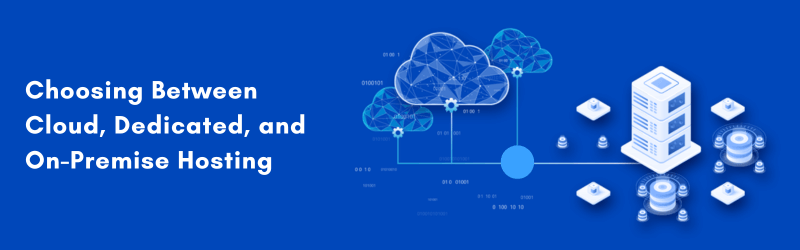
Choosing Between Cloud, Dedicated, and On-Premise Hosting
Each hosting model has distinct advantages for AI workloads.
With on-demand access to AI services, object storage, and GPU instances, cloud hosting is a perfect option for early-stage startups, and teams that want flexibility. For example, platforms like AWS, Google Cloud, and Azure allow you to quickly experiment and scale your project without costly hardware.
For steady, large-scale AI efforts, dedicated GPU servers are a better long-term ROI. These bare-metal environments allow for the maximum amount of performance, and control, which is the most important thing for businesses training custom models on large datasets.
On-Premise Hosting
Many businesses with strict requirements around data sovereignty or compliance are electing to use an on-premise AI infrastructure. While very expensive to set up, there is the utmost control over data privacy, latency, and customization of the system with on-premise.
In many cases, a hybrid infrastructure—cloud for development, and on-prem for deployment—is often the right fit.
Security and Compliance for AI Data
AI solutions increasingly interact with sensitive or regulated information as AI systems and platforms are quickly becoming solutions for regulated industries (e.g., healthcare, finance, etc.), resulting in a secure hosting infrastructure is absolutely critical).
The encryption of info at rest and info in transit is vital for the protection of intellectual property and user privacy. A Secure and Safe hosting environment should include role-based access, multi-factor authentication, and real-time monitoring to capture unauthorized access or anomalies.
For highly regulated industries, such as healthcare and finance, look for hosting solutions that are GDPR, HIPAA or SOC 2 compliant (furthermore, ensure that your AI environment is not only performance compliant but is also legally and ethically compliant as well).
Cost Management in AI Hosting
Running AI workloads can be an expensive proposition—especially cloudy GPU times. Fortunately, there are a couple of ways to optimize costs:
- Use spot or reserved instances for non-critical workloads.
- Profile your workloads to find when you may effectively take advantage of smaller GPUs or possibly even CPUs.
- Use inference optimization tools like NVIDIA Triton to improve throughput without scaling resources.
If you are spinning lots of training cycles, don’t forget to also consider buying GPU servers as they may be the more cost-effective option over time compared to renting by the hour in the cloud.
Leading Hosting Providers for AI
There are now many hosting options available with infrastructure suited for AI and ml:
- AWS: EC2 P5 instances, SageMaker, S3 storage, large ML ecosystem
- Google Cloud: Vertex AI, TPU support, BigQuery for ML datasets
- Microsoft Azure: GPU-enabled VMs, Azure ML, enterprise-integrated security
- Lambda Labs: Inexpensive GPU cloud for research and development
- Oracle Cloud Infrastructure (OCI): Economical high speed GPUs with RDMA networking
The provider you select will depend on the size of the workload, expertise of the team, budget and compliance.
Conclusion: Hosting for the Intelligence Revolution
As AI transitions from pilot projects to operationalized projects, your hosting infrastructure becomes a true competitive advantage. Your infrastructure must be more than simply compute; it should deliver speed, flexibility, scalability, and security.
Whether you’re building an AI-driven application, training large language models, or deploying computer vision in real-time, your success is contingent on having infrastructure specifically designed for the demands mandated by AI.
The AI paradigm shift is about more than data or algorithms—it’s about where and how you run them. Make smart choices. Choose smart hosting.