Choosing a domain name looks simple from the outside. You pick a brand name, check availability, pay for registration and move on. But for a Dutch business, the decision between .nl, .com and .eu can quietly shape how customers see your brand, how easily they remember your website and how confidently they choose to buy from you.
Your domain extension is not just a technical ending. It gives a signal. A .nl domain says you are locally connected to the Netherlands. A .com domain gives your business a more global feel. A .eu domain positions your brand across the European market. Each one has value, but the best choice depends on your business model, target customers and future expansion plans.
So, should your Dutch business register .nl, .com or .eu? Let’s break it down clearly.
Why Your Domain Extension Matters
Before comparing each option, it is important to understand why this decision matters in the first place. Your domain name is often the first branded asset a customer notices. It appears in search results, emails, invoices, business cards, ads, WhatsApp messages and social media profiles.
A good Dutch business domain name should do three things well: build trust, make your brand easy to remember and match your target market. If your business mostly serves customers in Amsterdam, Rotterdam, Utrecht, Eindhoven or anywhere in the Netherlands, the domain extension should make that local connection clear. If you plan to sell internationally, your domain should not feel too limited.
Official Dutch business guidance also recommends checking domain availability and making sure the domain name does not infringe another company’s trademark or trade name rights before registration.
What Makes a .nl Domain a Strong Choice?
For most Dutch businesses, .nl is the most natural and trusted choice. It is the country-code domain extension for the Netherlands and is widely recognized by Dutch consumers. If someone sees a business using a .nl domain, they immediately understand that the brand is connected to the Dutch market.
This matters a lot for local trust. Dutch customers are more likely to feel comfortable visiting, contacting or buying from a business that appears local. For service companies, consultants, agencies, restaurants, real estate firms, local shops and B2B companies operating mainly in the Netherlands, .nl is usually the strongest primary domain.
A .nl domain for Dutch business also makes sense from a branding angle. It keeps the name short, clean and locally relevant. If your company name is available in .nl, it is usually worth securing it quickly. SIDN, the registry behind .nl, allows users to check whether a .nl domain is available through its Whois/domain lookup, and .nl domains are registered through a registrar or hosting provider.
Best for:
A .nl domain is best for businesses targeting Dutch customers, local SEO, Dutch-language websites, physical stores, local service providers, Dutch startups and companies that want a strong Netherlands-based identity.
Possible limitation:
The only downside is that .nl may feel slightly local if your long-term plan is to build a global brand. That does not make it weak. It simply means you may also want to secure the .com version for future protection.
When Should You Choose a .com Domain?
The .com domain is still the world’s most recognized domain extension. People naturally type .com when they are unsure of a website address, and many international brands prefer it because it feels universal. Verisign operates the authoritative registry for .com and .net domain names.
For a Dutch business that wants to serve international clients, export products, sell SaaS, run an eCommerce platform or build a brand beyond the Netherlands, .com can be a powerful choice. It gives you room to grow without being tied to one country.
In the .com vs .nl domain decision, the main question is not which one is “better.” The real question is: where is your customer?
If your audience is mostly Dutch, .nl gives stronger local relevance. If your audience is global, .com gives broader recognition. If you serve both, the smartest move is often to register both and choose one as the main website.
Best for:
A .com domain is ideal for international businesses, SaaS companies, export businesses, global eCommerce brands, tech companies, agencies serving multiple countries and companies that want a premium worldwide brand feel.
Possible limitation:
The biggest issue with .com is availability. Many strong .com names are already taken, parked or priced very high in the resale market. You may need to be more creative with your brand name if you want a clean .com domain.
Where Does .eu Fit for a Dutch Business?
The .eu domain is designed for businesses, organizations and individuals connected with the European Union and related eligible regions. It can be a smart option if your Dutch business wants to position itself as a European brand instead of only a Netherlands-focused company.
For example, if you sell across the Netherlands, Belgium, Germany, France and other EU markets, a .eu domain registration may support that wider European identity. It is especially useful for companies in logistics, consulting, software, exports, manufacturing, education, compliance, sustainability or cross-border eCommerce.
However, .eu is not open in the same way as .com. Eligibility applies. For .eu domains, the registrant must generally be an eligible EU/EEA-connected individual, undertaking or organization under the applicable rules. WIPO’s .eu dispute guidance summarizes the eligibility criteria, including EU, Iceland, Liechtenstein or Norway citizenship/residence or establishment requirements.
Best for:
A .eu domain is best for businesses targeting multiple European countries, EU-facing brands, cross-border sellers, European institutions, export companies and brands that want a broader European identity.
Possible limitation:
In the Netherlands, .eu may not feel as familiar or local as .nl. If you are mainly targeting Dutch customers, .nl will usually create stronger trust.
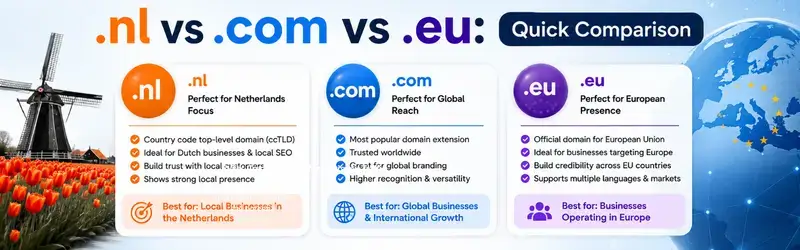
.nl vs .com vs .eu: Quick Comparison
| Domain Extension | Best Use | Brand Signal | Good for Dutch SEO? | Main Concern |
|---|---|---|---|---|
| .nl | Local Dutch business | Trusted, local, Netherlands-focused | Strong for Dutch audience | Less global feel |
| .com | International brand | Global, commercial, familiar | Good, but less locally specific | Availability and cost |
| .eu | European market | EU-focused, cross-border | Useful for European reach | Eligibility and lower local familiarity |
Which Domain Is Best for SEO?
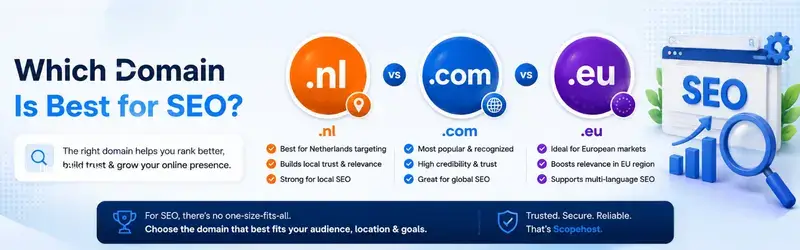
A domain extension alone will not magically rank your website. Google looks at content quality, technical SEO, backlinks, user experience, page speed, relevance and authority. But your domain can still support user trust and click-through rate.
For Dutch SEO, a .nl domain can be helpful because users instantly understand the local connection. If someone searches for a local service in the Netherlands and sees a clean .nl domain, it may feel more relevant. That can improve clicks, especially when combined with strong title tags, meta descriptions and locally optimized content.
For international SEO, .com gives you more flexibility. You can create country-specific folders like /nl/, /de/ or /fr/ and build multilingual content under one global brand.
For European SEO, .eu can work well when your brand genuinely serves multiple EU markets. But if you are targeting only the Netherlands, .eu may not give the same local confidence as .nl.
The Smartest Strategy: Register More Than One
Here’s the practical answer: if your budget allows, do not think of this as only one domain. Think of it as brand protection.
For a serious Dutch business, the best setup is often:
- Register yourbrand.nl as the main website if your core market is the Netherlands.
- Register yourbrand.com to protect your international brand identity.
- Register yourbrand.eu if you plan to serve customers across Europe.
You do not need to build separate websites on all three. You can keep one primary domain and redirect the others to it. This prevents competitors, resellers or unrelated businesses from using a similar domain and confusing your customers.
For example, if your main website is yourbrand.nl, you can redirect yourbrand.com and yourbrand.eu to it. Later, if your business expands internationally, you can switch your main domain strategy without losing the brand assets.
What Should a Local Dutch Business Choose?
If your business serves Dutch customers first, choose .nl as your primary domain. It is simple, trusted and locally relevant. This applies to restaurants, clinics, accountants, consultants, agencies, builders, salons, legal firms, schools, shops and local eCommerce brands.
Your customers should not have to think twice. When they see your domain, they should immediately feel, “Yes, this business is for the Netherlands.”
What Should a Dutch Startup Choose?
For startups, the answer depends on the ambition. If you are building a local platform, marketplace or service business, start with .nl. If your startup is SaaS, tech, export or global from day one, try to secure .com first. If .com is not available, use .nl as the main domain and keep searching for a strong global alternative.
A startup should also avoid long, confusing or hyphen-heavy domain names. A clean .nl is usually better than a messy .com.
What Should an Export or EU-Focused Business Choose?
If your Dutch company is selling across Europe, register .com and .eu, along with .nl. Use .com if you want a global commercial identity. Use .eu if your positioning is strongly European.
For example, a Dutch logistics company serving Germany, Belgium and France may benefit from a .eu domain. But it should still protect the .nl version because local Dutch customers may search for it naturally.
Final Recommendation
For most Dutch businesses, .nl should be the first choice. It is trusted, local and highly relevant for customers in the Netherlands. If your business has international plans, register .com as well. If your business actively serves the European market, add .eu to your domain portfolio.
The best domain strategy is not only about today’s website. It is about protecting your brand for the next five to ten years. Your domain name will appear everywhere your business appears online, so choose one that supports trust, growth and long-term visibility.
At ScopeHosts, you can secure your domain name along with reliable hosting, business email, DNS management and SSL support. Whether you are launching a Dutch local business, building an international brand or expanding across Europe, choosing the right domain is the first step toward building a strong online presence.