The rise of digital entertainment has transformed how audiences consume content. From binge-watching series to live sports streaming, Over-The-Top (OTT) platforms have become the backbone of modern media delivery. But behind every seamless streaming experience lies a complex infrastructure designed to handle millions of users simultaneously.
If you’re planning to build an OTT platform in 2026, the challenge is no longer just about launching an app; it’s about ensuring scalability, performance, and ultra-fast video delivery under heavy traffic conditions.
This guide breaks down everything you need to know about building a high-performance OTT system that delivers smooth playback, even during peak loads.
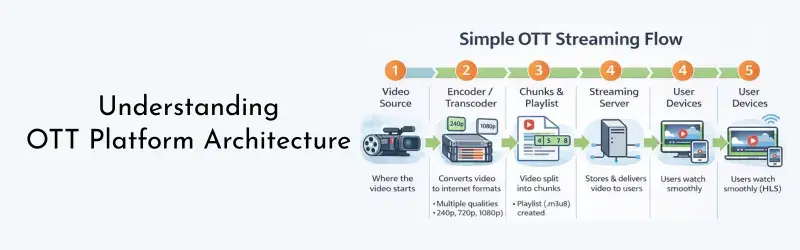
Understanding OTT Platform Architecture
At its core, an OTT platform consists of multiple layers working together:
- Content ingestion and processing
- Storage and media management
- Streaming and delivery
- User interface and experience
- Analytics and monetization
Each layer must be optimized to support OTT high traffic infrastructure while maintaining reliability and speed.
A poorly designed system can lead to buffering, downtime, and user drop-offs—something no streaming platform can afford.
Why it’s important to be able to handle a lot of traffic
There are times when OTT platforms see big surges that are hard to foresee. A movie release, a live match, or a viral show can quickly get millions of people online.
Without proper infrastructure:
- Servers crash
- Videos buffer endlessly
- Users abandon the platform
Handling high traffic is not optional—it’s fundamental.
To support such demand, your platform must:
- Scale instantly
- Distribute load efficiently
- Maintain consistent performance
Key Components of OTT High Traffic Infrastructure
1. Dedicated Streaming Servers
Any OTT platform needs a solid streaming server setup to work.
Unlike shared hosting, dedicated streaming servers provide:
- High bandwidth capacity
- Low latency
- Consistent performance
For OTT platforms, using Streaming media servers ensures that video content is delivered efficiently without interruptions.
Popular technologies include:
- Nginx with RTMP module
- Wowza Streaming Engine
- Red5
- Custom media servers
These servers handle encoding, streaming protocols, and user requests simultaneously.
2. Content Delivery Network (CDN)
A CDN is essential for distributing content globally.
Instead of serving videos from a single server, CDNs cache content across multiple geographic locations.
Benefits include:
- Reduced latency
- Faster video start time
- Lower server load
When users request content, it is served from the nearest node—ensuring fast video loading OTT experiences.
3. Adaptive Bitrate Streaming (ABR)
Not everyone has the same speed on the internet. Adaptive Bitrate Streaming changes the quality of the video based on how much broadband the user has.
This ensures:
- Smooth playback
- Reduced buffering
- Better user experience
Protocols like HLS and DASH are widely used for this purpose.
4. Load Balancing
Load balancers distribute incoming traffic across multiple servers.
This prevents:
- Server overload
- Downtime
- Performance bottlenecks
Types of load balancing:
- Round-robin
- Least connections
- IP hashing
A smart load balancing strategy is critical for OTT high traffic infrastructure.
5. Scalable Storage Solutions
OTT platforms require massive storage for video content.
Options include:
- Cloud storage (AWS S3, Wasabi, Backblaze)
- Distributed storage systems
- Hybrid storage setups
Storage must support:
- High-speed retrieval
- Redundancy
- Scalability

Optimizing for Fast Video Loading
Fast loading is what keeps users engaged.
Even a delay of 2–3 seconds can increase bounce rates significantly.
1. Efficient Video Encoding
Videos should be compressed without compromising quality.
Use codecs like:
- H.264
- H.265 (HEVC)
- AV1
Proper encoding reduces file size and improves delivery speed.
2. Smart Caching Mechanisms
Caching frequently accessed content reduces server load.
Types of caching:
- Edge caching (via CDN)
- Browser caching
- Server-side caching
This directly improves fast video loading OTT performance.
3. Preloading and Buffer Optimization
Preloading initial video segments ensures instant playback.
Optimizing buffer size helps balance:
- Startup time
- Playback smoothness
4. HTTP/3 and QUIC Protocol
Modern protocols like HTTP/3 improve:
- Connection speed
- Packet delivery
- Latency
This enhances overall streaming performance.
Choosing the Right Infrastructure Setup
Cloud-Based Infrastructure
Pros:
- Easy scalability
- Global reach
- Managed services
Cons:
- Higher cost at scale
Dedicated Server Infrastructure
Pros:
- Full control
- Cost-effective for high traffic
- Better performance
Cons:
- Requires management expertise
Hybrid Infrastructure
The best approach for many platforms.
Combines:
- Dedicated servers for core streaming
- CDN for distribution
- Cloud for backup and scaling
Security Considerations
OTT platforms deal with premium content, making security essential.
Key measures include:
- DRM (Digital Rights Management)
- Token-based authentication
- Secure streaming URLs
- DDoS protection
Without proper security, content piracy can damage revenue.
Database and Backend Optimization
Your backend must handle:
- User data
- Watch history
- Recommendations
- Payments
Use scalable databases like:
- MySQL clusters
- PostgreSQL
- NoSQL (MongoDB, Redis)
Caching layers like Redis improve response times.
Monitoring and Analytics
Real-time monitoring helps detect issues before users do.
Track:
- Server load
- Playback errors
- Buffering rates
- User engagement
Analytics tools provide insights to improve performance and content strategy.
Handling Live Streaming at Scale
Live streaming is more demanding than on-demand content.
Challenges include:
- Real-time encoding
- Minimal latency
- High concurrency
Solutions:
- Low-latency streaming protocols
- Edge processing
- Multi-CDN strategies
Multi-Device Compatibility
Users access OTT platforms from:
- Smartphones
- Smart TVs
- Tablets
- Laptops
Your platform must support:
- Responsive UI
- Multiple resolutions
- Cross-platform playback
Future Trends in OTT Platforms
1. AI-Based Recommendations
Personalized content improves engagement and retention.
2. Edge Computing
Processing data closer to users reduces latency.
3. 5G Streaming
- Ultra-HD streaming
- Low-latency live content
4. Interactive Content
- Live polls
- Multi-angle viewing
- Real-time interactions
Cost Optimization Strategies
Running an OTT platform can be expensive.
To optimize costs:
- Use efficient codecs
- Implement smart caching
- Optimize bandwidth usage
- Choose the right server locations
Dedicated Streaming media servers often provide better ROI for large-scale platforms.
Common Mistakes to Avoid
- Ignoring scalability
- Using low-quality hosting
- Not implementing CDN
- Poor encoding practices
- Lack of monitoring
Final Thoughts
To make an OTT platform work, you need the right technology, strategy, and infrastructure.
To truly succeed, your platform must:
- Handle massive traffic effortlessly
- Deliver content instantly
- Scale without downtime
Your platform will always work well, even when things get busy, thanks to a powerful OTT high traffic infrastructure, optimal Streaming server installations, and global distribution.
If you want to build an OTT platform in 2026, you need to focus on a performance-first architecture. In the era of streaming, speed and reliability aren’t simply nice to have; they’re expected.