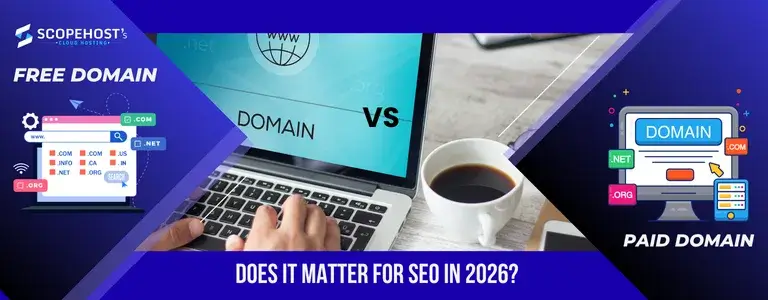
Free domain vs paid domain is a topic many beginners and small business owners still debate in 2026. With website builders and hosting platforms offering free website domains instantly, many people wonder whether paying for a custom domain name is truly necessary for SEO and online growth.
The short answer is yes, it does matter, but not always in the way people think.
Search engines have gotten smarter over the years. Google doesn’t rank pages based on keywords or backlinks anymore. User trust, branding, experience, authority and quality of website are increasingly much greater factors. Your domain name might not be an immediate ranking factor but it effects the perception of your website by users and search engines.
Before you start your website, it’s crucial to grasp the difference between free and paid domains if you aim to create a meaningful online presence.
What Is a Free Domain?
A free domain is usually provided by:
- Website builders
- Free hosting platforms
- Blogging platforms
- Trial hosting services
Instead of getting a fully independent custom domain, your website operates under a subdomain.
Examples:
- yoursite.platformname.com
- yourbrand.freehost.net
- businessname.websitebuilder.io
These domains cost nothing initially and allow users to launch websites quickly.
Free domains are often used for:
- Personal projects
- Testing websites
- Student portfolios
- Temporary landing pages
- Hobby blogs
They are useful for experimentation but come with several limitations.
What Is a Paid Domain?
A paid domain is a custom domain name registered independently through a domain registrar.
Examples:
- yourbrand.com
- yourbusiness.in
- yourstore.net
You fully own and control the domain as long as you renew it regularly.
Paid domains allow businesses and website owners to create professional branding and long-term authority online.
Does Google Directly Penalize Free Domains?
This is one of the biggest misconceptions in SEO. Google does not officially state that free domains automatically rank lower than paid domains.
A website hosted on a free subdomain can still rank if:
- the content is valuable
- the website loads properly
- the user experience is good
- backlinks are strong
- technical SEO is optimized
Why Paid Domains Usually Perform Better
Better User Trust
Trust is one of the strongest factors affecting online behavior.
When users see a domain like:
- businessname.com
they immediately perceive it as more professional compared to:
- businessname.freewebsite.com
Visitors are more likely to:
- stay longer
- click links
- submit forms
- make purchases
Stronger Branding Opportunities
A custom website domain name helps build brand recognition. People remember shorter, cleaner domains more easily.
Paid domains also allow:
- branded emails
- better marketing campaigns
- stronger social media consistency
- improved credibility
Full Ownership and Control
With free domains, you usually do not fully control the platform.
The provider may:
- remove your website
- suspend accounts
- display ads
- limit customization
- restrict SEO settings
Paid domains give you complete ownership over your website identity.
How Free Domains Can Affect SEO
Limited Authority
Many free subdomain platforms have been abused for spam over the years. Because of this, some free domain ecosystems carry lower trust levels overall. Even if your website is legitimate, users and search engines may approach it cautiously.
Weak Backlink Value
Most typically, the branding value of a free subdomain is retained by the parent platform, not your own name, when websites link to it.
Reduced Click-Through Rates
Search engine users tend to trust clean custom domains more than long subdomains. This affects click-through rates in search results.
For example:
- yourstore.com usually appears more trustworthy than:
- yourstore.freebuilderplatform.com
Harder Brand Recognition
SEO today is not just about rankings. It is also about brand searches. People searching directly for your business name is a strong signal of authority.
Are There Situations Where Free Domains Are Fine?
Yes, absolutely. A free website domain can still work for:
- Learning web development
- Temporary projects
- Internal company testing
- Student assignments
- Personal experiments
- Prototype websites
If SEO and branding are not major priorities yet, free domains can be a practical starting point.
Many people begin with free platforms before moving to professional hosting and custom domains later.
Why Businesses Should Avoid Free Domains
For businesses, credibility matters heavily. A paid domain creates a stronger impression for:
- customers
- investors
- partners
- search engines
Using free domains for business websites may create concerns about:
- professionalism
- security
- legitimacy
- reliability
Domain Extensions and SEO in 2026
Another common question is whether domain extensions matter.
Popular extensions include:
- .com
- .in
- .net
- .org
- .io
- .co
Google has confirmed that modern extensions can rank equally if the website quality is strong.
However, users still tend to trust familiar extensions like:
- .com
- .org
- country-specific domains
more than unusual or spam-associated extensions.
Does Domain Age Matter?
Domain age itself is not a major ranking factor.
A new paid domain can outrank older websites if:
- the content quality is better
- technical SEO is optimized
- user experience is stronger
- backlinks are higher quality
However, older domains often accumulate authority naturally over time.
SEO Factors That Matter More Than Domain Type
While domain name SEO matters indirectly, several factors are far more important for rankings in 2026.
High-Quality Content
Search engines prioritize useful, original, and relevant content.
Website Speed
Fast-loading websites provide better user experiences and improve engagement.
Mobile Optimization
Most internet traffic now comes from mobile devices. Responsive websites perform better in search results.
Backlinks
Strong backlinks from trusted websites continue to influence rankings heavily.
User Experience
Search engines evaluate how users interact with websites. Easy navigation and readability matter significantly.
Technical SEO
Proper indexing, schema markup, internal linking, and crawl optimization remain important.
The Hidden Problem With Free Platforms
Many free website builders limit advanced SEO customization.
Restrictions may include:
- limited metadata control
- forced ads
- poor page speed
- restricted plugin access
- limited schema implementation
- weak URL structures
Long-Term Growth and Scalability
A website is often a long-term investment.
As your business grows, you may need:
- custom applications
- eCommerce functionality
- advanced analytics
- custom email systems
- API integrations
- SEO tools
Paid domains and independent hosting environments offer greater scalability and flexibility.
How Paid Domains Improve Professionalism
In 2026, online competition is stronger than ever. Users quickly judge websites based on appearance and trust.
A professional domain contributes to:
- stronger first impressions
- improved conversion rates
- higher trust levels
- better sharing potential
- stronger brand identity
Is a Paid Domain Expensive?
Not really. Most domain names cost relatively little annually compared to the value they provide.
For businesses, a domain is one of the most affordable long-term branding investments.
Conclusion: Does It Matter for SEO in 2026?
Technically, Google can rank both premium domains and free domains. But in the real world of SEO, premium domains nearly always beat the others over time since they improve trust, branding, authority, scalability, click-through rates, and professionalism.
A free domain is fine for testing or learning, but serious websites that want to be seen and grow over the long run should invest in a professional custom domain name.
It’s all about reputation and user trust, just like keywords and backlinks, they’re becoming just as crucial to SEO. A premium domain is a better basis for both search engine performance and business success.