
A slow website can be frustrating for both visitors and website owners. Pages take longer to load, users leave before the content appears, and even simple actions can feel unnecessarily delayed.
But is your website code always responsible?
Not necessarily.
Your website hosting environment can have a major impact on how quickly your website responds to visitors. Server resources, storage technology, network performance, server location, traffic levels, and hosting configuration can all influence website speed.
If your website was fast when it launched but has gradually become slower, your hosting environment may be one of the areas worth investigating.
Here are 15 web hosting reasons that could be affecting your website performance.
Your Hosting Plan Has Limited Resources
Every website needs resources such as CPU, RAM, storage, and processing capacity.
When a hosting plan provides fewer resources than your website requires, pages may take longer to process. This becomes more noticeable as your website grows, receives more visitors, or adds resource-intensive features.
A hosting plan that was perfectly adequate for a small website may eventually become insufficient.
If your account regularly reaches CPU, memory, or process limits, the hosting environment could be contributing to your slow website.
Too Many Websites Share the Same Server
Shared hosting works by placing multiple websites on the same physical server.
This makes hosting affordable and practical for many websites, but server resources are shared between accounts.
If several websites on the same server suddenly receive high traffic or consume large amounts of CPU and memory, overall server performance can be affected.
This doesn’t mean shared hosting is inherently slow. A properly managed and appropriately loaded server can perform well. However, resource contention can become a problem when demand exceeds available capacity.
Your Server Is Overloaded
Even a powerful server can become overloaded.
High CPU usage, insufficient RAM, too many processes, traffic spikes, or resource-heavy applications can push a server beyond its comfortable operating capacity.
An overloaded server may take longer to respond to requests, resulting in increased server response times and slower page loading.
If your website becomes noticeably slower during particular periods, checking server resource usage can help identify whether capacity is the problem.
Your Hosting Uses Slow Storage
Storage technology can have a surprisingly large effect on website performance.
Websites constantly read and write files. Databases also depend on storage performance when processing queries and transactions.
Traditional hard disk drives are generally slower than SSD and NVMe storage, especially when dealing with frequent input and output operations.
Modern website hosting infrastructure often uses faster storage to reduce these delays.
For database-heavy websites, e-commerce platforms, and applications with frequent file operations, storage performance can be particularly important.
Your Website Doesn’t Have Enough RAM
RAM allows the server to keep active processes and frequently accessed information readily available.
When available memory is insufficient, the server may struggle to handle simultaneous requests efficiently.
This can affect websites running content management systems, databases, e-commerce platforms, and custom applications.
As traffic grows, memory requirements can increase as well. If your website regularly reaches its memory limits, upgrading resources may improve overall responsiveness.
High CPU Usage Is Slowing Requests
The server’s CPU handles many of the operations required to generate dynamic web pages.
For example, a visitor opening a page on a dynamic website may trigger PHP scripts, database queries, plugins, APIs, and other processes before the final page is delivered.
If CPU usage is consistently high, these processes may take longer to complete.
High CPU usage can be caused by:
- Resource-heavy plugins
- Poorly optimized applications
- Large database queries
- High visitor traffic
- Background processes
- Inefficient scripts
Identifying the cause is important because simply increasing server resources may not solve an underlying software problem.
Your Database Is Taking Too Long to Respond
Many modern websites depend heavily on databases.
WordPress websites, online stores, membership websites, booking systems, and custom applications may execute numerous database queries when a visitor loads a page.
As databases grow, inefficient queries, missing indexes, excessive data, or insufficient server resources can increase response times.
A slow database can therefore contribute directly to a slow website.
Database optimization, appropriate indexing, caching, and suitable server resources can help improve performance.
Your Server Configuration Isn’t Optimized
Good hardware alone doesn’t guarantee good performance.
The configuration of the server also matters.
Web server settings, PHP workers, database parameters, caching, compression, connection limits, and other configuration settings can affect how efficiently requests are processed.
A server configured for a basic website may not be ideal for a high-traffic e-commerce store or resource-intensive application.
This is why the hosting environment should be configured according to the workload it needs to handle.
Server-Side Caching Is Missing
Caching reduces the amount of work a server needs to perform for repeated requests.
Without effective caching, the server may repeatedly process the same application code and database queries every time visitors request a page.
Server-side caching can store frequently requested information and deliver it more efficiently.
Depending on the technology being used, caching can exist at several levels, including:
- Web server caching
- Application caching
- Database caching
- Object caching
- Full-page caching
Proper caching can significantly improve website speed, particularly for websites with frequently accessed content.
Your Website Is Experiencing Traffic Spikes
A website may perform perfectly under normal traffic but slow down when visitor numbers suddenly increase.
Traffic spikes can happen because of:
- Advertising campaigns
- Social media activity
- Product launches
- Seasonal promotions
- News coverage
- Viral content
If the hosting environment doesn’t have enough capacity to handle peak demand, server response times can increase or the website may become temporarily unavailable.
Planning hosting capacity around peak traffic—not just average traffic—is important for growing websites.
Your Server Is Located Too Far From Your Visitors
Physical distance can influence network latency. If most of your visitors are located in one country but your server is located thousands of kilometres away, requests and responses may need to travel a longer network path. The difference isn’t always dramatic, but latency can become more noticeable for websites with visitors spread across different regions.
Choosing an appropriate server location based on your primary audience can help reduce unnecessary network delay.
A Content Delivery Network (CDN) can also help deliver static content closer to users around the world.
Your Hosting Has Network or Bandwidth Limitations
Your server needs a reliable network connection to deliver website files to visitors. Network congestion, bandwidth limitations, routing problems, or infrastructure issues can affect how quickly content reaches users.
This is especially relevant for websites delivering large files, images, videos, downloads, or other bandwidth-intensive content.
A good web hosting environment should provide sufficient network capacity for the type and volume of traffic the website receives.
You Have Outgrown Your Current Hosting Plan
Websites evolve.
A website that started with a few pages may eventually have hundreds of pages, thousands of products, a larger database, more plugins, additional applications, and significantly more visitors.
As these requirements increase, the original hosting plan may no longer provide enough resources.
This is one of the most common reasons a previously fast website gradually becomes slower.
If resource usage consistently approaches the limits of your current plan, it may be time to consider a more suitable hosting environment.
Multiple Resource-Heavy Applications Are Running Together
Some businesses run several websites or applications within the same hosting environment.
For example, a single server might host:
- A corporate website
- An e-commerce store
- A staging website
- A customer portal
- Several databases
- Internal applications
If these workloads consume significant resources at the same time, they can compete for CPU, RAM, storage, and network capacity.
Separating demanding applications or moving them to infrastructure with greater capacity can help maintain more predictable performance.
Your Hosting Infrastructure Is Outdated
Sometimes the simplest explanation is that the underlying infrastructure is old.
Older processors, slower storage, outdated networking equipment, or inefficient server configurations can limit performance.
Modern hosting infrastructure can provide improvements through newer processors, faster SSD or NVMe storage, better networking, and more efficient server software.
If your website has already been properly optimized but continues to have poor server response times, the underlying hosting infrastructure is worth examining.
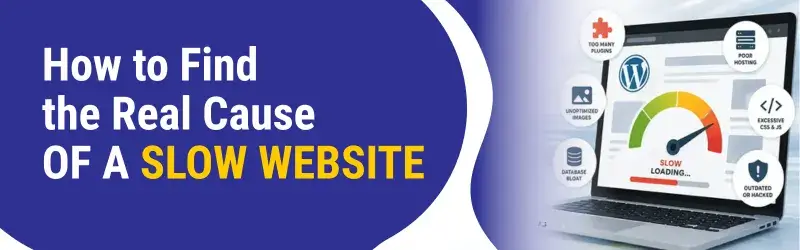
How to Find the Real Cause of a Slow Website
Before changing your hosting plan, it’s important to identify where the problem actually exists.
Start by checking your hosting resource usage. Look for unusually high CPU consumption, memory usage, storage problems, or process limits.
Then check your website’s server response time.
If the server takes a long time to respond before the page even starts loading, the hosting environment may be part of the problem.
If the server responds quickly but the page takes a long time to finish loading, the problem may instead involve images, JavaScript, CSS, third-party scripts, plugins, or other website-level issues.
Testing the website from different locations and at different times can also reveal whether the issue is related to traffic, network latency, or server capacity.
Does Better Hosting Always Make a Website Faster?
Not necessarily.
Better website hosting can provide more resources and a stronger infrastructure foundation, but hosting is only one part of website performance.
A poorly optimized website can remain slow even on a powerful server.
Large images, excessive plugins, inefficient code, unoptimized databases, third-party scripts, and missing caching can all contribute to poor performance.
The best approach is to optimize both sides:
Website optimization + suitable hosting infrastructure = better performance
If the website itself is optimized but the server remains underpowered, upgrading the hosting environment may provide a meaningful improvement.

When Should You Consider Changing Web Hosting?
You may want to consider changing or upgrading your web hosting when:
- Your server frequently reaches resource limits
- Website response times remain consistently high
- Traffic has grown significantly
- Your website experiences regular slowdowns
- You need more CPU or RAM
- You require faster storage
- Your current environment limits server configuration
- Your website needs to handle traffic spikes
- Your applications have outgrown shared resources
The goal isn’t simply to choose the most expensive hosting plan.
Instead, choose an environment that provides the resources, performance, flexibility, and scalability your website actually needs.
Final Thoughts
A slow website isn’t always caused by bad code or heavy images. Your hosting environment can play an equally important role in how quickly your website responds to visitors.
Limited resources, overloaded servers, slow storage, insufficient RAM, high CPU usage, database bottlenecks, poor configuration, network latency, and outdated infrastructure can all affect website speed.
The good news is that hosting-related performance problems can often be identified by monitoring server resources and measuring response times.
Before making a change, find the bottleneck first. If your website has outgrown its current website hosting environment, moving to infrastructure with better resources and performance can provide the foundation needed for continued growth.
Ultimately, fast websites aren’t created by one setting or one hosting plan. They come from the right combination of optimized websites, efficient applications, reliable infrastructure, and hosting resources that match the workload.