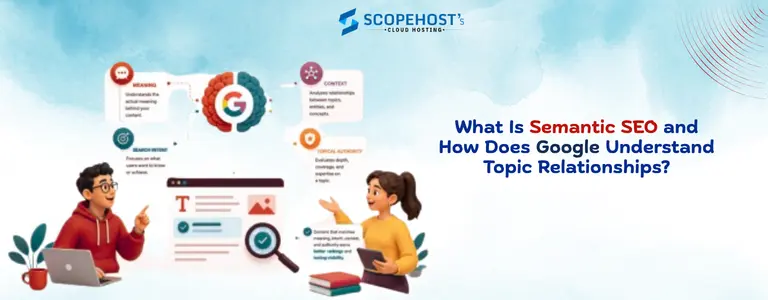
Search engines have become much smarter than simply matching keywords with web pages. In the early days of SEO, adding a target keyword repeatedly could help a page rank. Today, Google looks at the meaning, context, relationships, and relevance behind the content.
This is where semantic SEO becomes important.
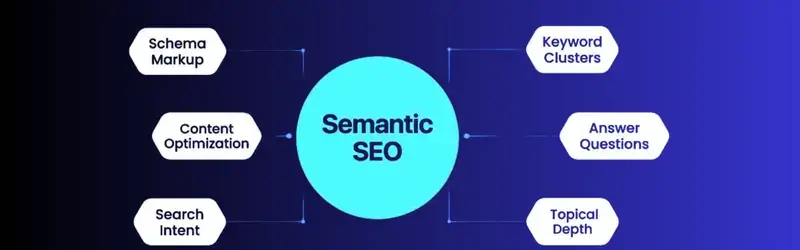
Semantic SEO is the practice of creating content that clearly covers a topic, its related concepts, entities, questions, and search intents. Instead of focusing on one keyword alone, it helps search engines understand what a page is about and how different pieces of information are connected.
For website owners, marketers, and content creators, understanding semantic SEO can make it easier to build useful content that satisfies users while giving search engines stronger signals about topical relevance.
What Is Semantic SEO?
Semantic SEO is an approach to search engine optimization that focuses on the meaning and context of content rather than relying only on exact-match keywords.
For example, suppose you are writing about “web hosting.” A search engine does not need to see the phrase “web hosting” in every paragraph to understand the topic. It can also identify related concepts such as:
- Shared hosting
- VPS hosting
- Cloud hosting
- Dedicated servers
- Server resources
- Website performance
- Uptime
- Bandwidth
- SSL certificates
- Domain names
- Server security
These terms and concepts help create a broader understanding of the subject.
A semantically optimized article therefore answers the main question while naturally covering related questions and concepts that users may expect to find.
The goal is not to insert as many related keywords as possible. The goal is to build meaningful connections between concepts and provide complete information.
How Does Semantic Search Work?
Semantic search allows search engines to interpret the meaning behind a query instead of treating it as a simple collection of words.
For example, a user searching for:
“best hosting for a growing business”
may not be looking for a page that simply repeats the phrase “best hosting for a growing business.”
They may want information about scalability, server resources, performance, reliability, security, pricing, and management requirements.
Google can use language understanding and other signals to determine the likely meaning and search intent behind a query.
This means two searches with different wording can sometimes lead to similar results because their underlying meaning is related.
For example:
- “How can I improve website loading speed?”
- “Ways to make my website faster”
- “Improve website performance”
Although the wording differs, the underlying topic is closely connected.
For content creators, this means writing naturally around a topic is generally more useful than trying to match every possible keyword variation exactly.
Why Is Semantic SEO Important?
Search behavior has changed significantly. People use conversational queries, specific questions, and longer searches to find information.
At the same time, search engines have improved their ability to understand language and relationships between concepts.
Semantic SEO matters because it can help a website:
1. Cover Topics More Completely
A page that addresses only one narrow keyword may leave important questions unanswered.
Semantic content considers the broader subject and provides useful supporting information.
2. Match Different Search Intents
One topic can have multiple types of intent.
For example, someone searching for “VPS hosting” might want:
- A definition
- Pricing information
- Technical specifications
- Comparison with shared hosting
- Benefits and disadvantages
- Setup guidance
Understanding these different needs helps create content that is more useful.
3. Build Topical Authority
Publishing well-connected content around a particular subject can help establish topical authority.
Instead of having one article about web hosting, a website might create related content covering:
- Web hosting basics
- VPS hosting
- Cloud hosting
- Dedicated hosting
- Website security
- Server performance
- DNS
- Website migration
These pages can support one another through logical internal linking.
4. Improve Content Relevance
When the main topic and supporting concepts are clearly connected, search engines can better understand what the page covers.
This does not guarantee higher rankings, but it creates stronger relevance signals and improves the usefulness of the content.
How Google Understands Topic Relationships
Google does not rely on a single factor to understand content. It uses various systems and signals to interpret language, pages, entities, links, and relationships.
A useful way to understand this is through entities and concepts.
An entity can be a person, organization, location, product, technology, or other identifiable concept.
For example, an article about “VPS hosting” may naturally mention:
VPS hosting → virtual server → operating system → CPU → RAM → storage → bandwidth → website performance
These concepts are connected.
When content consistently explains these relationships in a logical way, it becomes easier for both users and search engines to understand the subject.
Google can also examine how pages across a website relate to each other. Internal links, page structure, headings, and surrounding content can provide additional context.
The Relationship Between Search Intent and Semantic SEO
Understanding search intent is one of the most important parts of semantic SEO.
Search intent refers to the reason behind a user’s search.
Generally, search intent can be divided into four major categories:
Informational Intent
The user wants to learn something.
Examples:
- What is VPS hosting?
- How does DNS work?
- What is semantic SEO?
Navigational Intent
The user is trying to reach a particular website or page.
Examples:
- Google Search Console
- ScopeHosts login
- WordPress dashboard
Commercial Investigation
The user is researching options before making a decision.
Examples:
- VPS vs cloud hosting
- Best hosting for WordPress
- Managed vs unmanaged VPS
Transactional Intent
The user is ready to take an action, such as purchasing or signing up.
Examples:
- Buy VPS hosting
- Register a domain
- Purchase a dedicated server
A strong content strategy identifies the intent behind a query and creates content that satisfies that specific need.
Semantic SEO vs Traditional Keyword SEO
Traditional keyword-focused SEO often starts with a primary keyword and attempts to optimize a page around it.
Semantic SEO takes a broader approach.
| Traditional Keyword SEO | Semantic SEO |
|---|---|
| Focuses heavily on exact keywords | Focuses on topics and concepts |
| Targets individual phrases | Covers related entities and questions |
| Can encourage repetitive wording | Encourages natural language |
| Often centers on one page | Connects multiple related pages |
| Keyword density may receive excessive attention | Context and usefulness receive greater attention |
This does not mean keywords are no longer important.
Keywords still help search engines and users understand what a page is about. The difference is that modern SEO should use keywords naturally within comprehensive, useful content rather than forcing them into every section.
How to Create Content Using Semantic SEO
Creating semantically rich content does not require complicated techniques. A structured process can make it much easier.
Step 1: Identify the Main Topic
Start with one clear topic.
For example:
“VPS hosting for small businesses”
The article should have a clear purpose rather than trying to cover every aspect of hosting.
Step 2: Understand the Search Intent
Ask what the user actually wants to know.
Are they looking for a definition, comparison, tutorial, recommendation, or solution to a problem?
The content should answer that need early.
Step 3: Research Related Concepts
Identify concepts naturally associated with the main topic.
For VPS hosting, these could include:
- CPU
- RAM
- SSD storage
- Bandwidth
- Scalability
- Security
- Server management
- Operating systems
- Backup
- Uptime
Use these concepts only when they contribute useful information.
Step 4: Build a Logical Content Structure
Use descriptive headings and organize information from basic to advanced.
A typical structure might look like:
Main topic → Definition → Benefits → Features → Comparisons → Use cases → Common questions → Conclusion
This makes the article easier to navigate and understand.
Step 5: Answer Related Questions
Look for questions users commonly ask about the subject.
Adding relevant FAQs can improve usefulness and help address long-tail searches.
However, FAQs should provide genuine answers rather than exist solely to add keywords.
Internal Linking and Topical Authority
Internal linking plays an important role in creating a connected website structure.
Suppose a website has an article about VPS hosting. It could naturally link to related pages covering:
- VPS vs shared hosting
- VPS vs cloud hosting
- How to secure a VPS
- How to migrate a website
- Server monitoring
- Website performance optimization
This creates a network of related content.
Over time, a well-organized content cluster can contribute to stronger topical authority because the website demonstrates broad coverage of a subject instead of publishing isolated articles.
The key is relevance. Internal links should help users discover related information rather than being added simply for SEO purposes.
Semantic SEO and Content Quality
Semantic optimization should never replace good writing.
A page can contain dozens of related keywords and still perform poorly if the information is inaccurate, repetitive, difficult to read, or fails to answer the user’s question.
High-quality semantic content should be:
- Useful
- Accurate
- Well structured
- Easy to scan
- Written for humans
- Relevant to the search intent
- Supported by appropriate examples
- Updated when information changes
The best approach is to start with the user and then optimize the content so search engines can clearly understand it.

Common Semantic SEO Mistakes
Keyword Stuffing
Adding related keywords repeatedly does not make content more semantic.
Use terms where they naturally fit.
Covering Too Many Unrelated Topics
Semantic SEO does not mean writing everything about everything.
Stay focused on the primary topic and its genuinely related concepts.
Ignoring Search Intent
An article can be technically comprehensive but still fail if it does not answer what the searcher actually wants.
Creating Thin Supporting Pages
Publishing dozens of short pages simply to create a topic cluster can result in unnecessary content.
Every page should have a clear purpose.
Over-Optimizing Anchor Text
Internal links should use descriptive, natural anchor text. Repeating exact-match keywords excessively can make the content feel artificial.
The Future of Semantic SEO
Search is increasingly becoming more conversational and context-driven. Users may search through traditional queries, voice interfaces, AI-powered search experiences, and follow-up questions.
This makes contextual understanding even more important.
Businesses should therefore think beyond individual keywords and focus on building useful topic ecosystems.
Instead of asking:
“How many times should I use this keyword?”
A better question is:
“Does this page completely answer the user’s question and explain the concepts they need to understand?”
That shift captures the real value of semantic SEO.
Conclusion
Semantic SEO is about helping search engines understand the meaning, context, and relationships within your content while creating a better experience for users.
Rather than relying exclusively on exact-match keywords, successful SEO increasingly requires a combination of topic coverage, search intent, entities, contextual relevance, internal linking, and high-quality information.
Understanding semantic search can also help businesses build stronger content strategies. By creating connected pages around important subjects, answering related questions, and organizing information logically, websites can develop stronger topical authority and provide more value to their audiences.
The simplest way to approach semantic SEO is this: don’t write for a keyword; write to fully solve the user’s problem. When the content is genuinely useful, naturally structured, and contextually relevant, both users and search engines have a clearer reason to trust and understand it.