Introduction—Why Web Server Choice Impacts WordPress Hosting Performance
Most people looking at the performance of WordPress hosting look at CPU, RAM, SSD speed, or caching plugins, but the web server – the underlying software that delivers content on the web – influences the performance you see in practice. Regardless of whether it’s LiteSpeed, NGINX, or Apache, your server stack influences its speed, scalability, and stability.
As we look towards 2026 the needs of high traffic WordPress sites are increasing. Sites must now manage larger increases in web traffic, more dynamic content, and increased security needs. Choosing a web host is not just a technical decision, but a business-critical one with implications for SEO, conversion rates, and hosting costs.
In this extensive WordPress hosting benchmark comparison, we will review LiteSpeed, NGINX, and Apache’s performance under WordPress workloads and compare each in more detail regarding caching, dynamic content, and overall hosting efficiency.

Understanding WordPress Hosting Benchmarks and Core Metrics
Before we go over the results, it’s important to understand what we mean by the WordPress hosting benchmarks being measured as well as why those benchmarks matter.
The following metrics from the basis for web server comparisons:
- Requests per Second (RPS): It measures how many requests your server can perform a second. The higher your RPS equals better scalability.
- Time to First Byte (TTFB): Indicates how fast the browser is receiving the first byte of data. The lower your TTFB equals faster perceived loading speed.
- 95th Percentile Latency: indicates how your server performs under high load. This is important for eCommerce, or any WordPress hosting with high traffic.
- CPU and Memory Usage: determines efficiency of how much hardware power it takes to serve your site.
- Cache Hit Ratio: The percent of requests that were served from cache vs PHP/MySQL. The higher the cache hit ratio the better, retrieved data from cache creates tremendous increases in WordPress hosting performance.
Reliable WordPress hosting benchmarks will simulate real-world traffic using tools like k6, wrk, or ApacheBench, and tests should always include cached and unprocessed pages for accuracy.
LiteSpeed Web Server – LSCache, LSAPI, and Managed WordPress Hosting Benefits
LiteSpeed Web Server has emerged as a formidable player in the managed WordPress hosting market. LiteSpeed Web Server is built with a very efficient event-driven architecture, with several unique features that make it perfect for running WordPress.
Key Technologies
- LSAPI (LiteSpeed SAPI): A custom PHP interface built with performance in mind, which minimizes the latency that exists when the server communicates calls between the server and the PHP process.
- LiteSpeed Cache (LSCache): A full-page server-level cache that is part of the WordPress plugin and serves cached pages directly at the web server layer.
- QUIC and HTTP/3 Support: Allow for faster delivery of content, and lower latency to connect.
LiteSpeed excels at optimization right out of the box. With the LiteSpeed Cache plugin, WordPress sites can see 40–70% faster loading times than standard Apache.
For WordPress hosting providers, LiteSpeed offers:
- Lower CPU consumption per user.
- Higher RPS under load.
- Simplified caching and optimization setup.
LiteSpeed Enterprise requires a paid license to use, but the open-source OpenLiteSpeed is free and powerful enough to be used in many VPS or cloud WordPress hosting situations.
NGINX Web Server – FastCGI, PHP-FPM, and High-Concurrency WordPress Sites
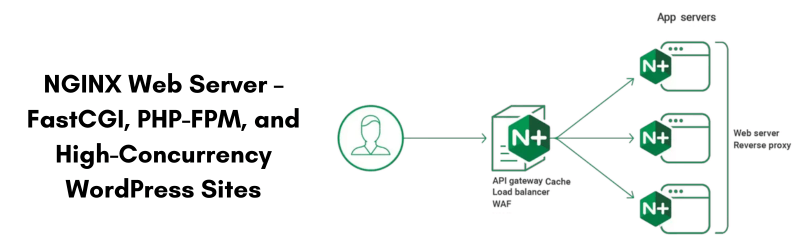
NGINX is the engine behind a lot of high-performance WordPress hosting platforms and CDNs because of its event-driven, non-blocking architecture. It is known for its efficient use of memory while managing thousands of concurrent connections.
Core Components
- PHP-FPM (FastCGI Process Manager) – Separates PHP processing from the web server for more flexibility and control.
- FastCGI Cache – Provides fast, disk-based page caching directly at the server layer.
- Reverse Proxy Support – Allow server-side load balancing while taking advantage of convenient caching layers like Redis or Varnish.
In terms of uncached dynamic WordPress pages, the performance of NGINX with PHP-FPM is comparable to that of LiteSpeed with its LSAPI. However, with respect to cache, LiteSpeed’s native cache outperforms manual FastCGI caching (without tuning) set up in NGINX.
For these reasons, many VPS hosting providers and cloud hosting providers prefer NGINX – they can easily customize the control over their stance to get whatever performance they want. This can be helpful for developers, agencies, or hosting providers who have the option of customizing that stack if they wish.
Apache Web Server – Legacy Power, Compatibility, and Shared Hosting Role
Apache is still the most common software for server management on the web. It has been the choice for shared WordPress hosting for some time. While LiteSpeed and NGINX have offered performance alternatives, it remains largely due to how flexible and compatible Apache is.
Why Apache Still Matters
- .htaccess: This is important for WordPress and many other CMS and plugins, as it allows for per-directory configuration.
- Compatibility: It works with older PHP applications and WordPress plugins without compatibility problems.
- Modules system: These modules give you flexibility in how you serve your content with mod_rewrite, mod_security, and caching (just to name a few).
However, Apache’s prefork and worker MPMs with high concurrency will consume resources quickly, making it less ideal for high-traffic or high-demand WordPress hosting.
Apache can be sufficient for medium traffic websites when used with mod_php or PHP-FPM and also an adequate cache layer such as WP Super Cache or W3 Total Cache.
Apache is typically still the software of choice for budget shared hosting providers who promote stability and simplicity over throughput and usage efficiency.

Testing Your Own WordPress Hosting Environment
Knowing these benchmarks is useful, but running tests in your own environment gives you the most relevant information. When assessing your WordPress hosting performance, always test on a staging copy of your actual site, using all of your active plugins, with a similar database size, caching configuration, etc. Generate traffic and conduct the tests under real-world conditions so the tests do not yield misleading results.
Use benchmark tools like k6, wrk, or ApacheBench to generate traffic and measure request throughput and latency. Be sure to test both cached and uncached responses. Many sites represent themselves well when serving cached pages, but can fail to generate a page for dynamic content. As you test performance with generated traffic, record your metrics including TTFB, CPU load, memory, etc., as you gradually increase the concurrent users and discover where your bottlenecks occur.
You could also leverage monitoring tools like New Relic or UptimeRobot to visualize real-time performance under load. Performance should be regularly benchmarked to keep an eye on your WordPress hosting provider and verify that they are serving optimal performance over time as your site scales and increases in traffic levels.
Final Verdict – Choosing the Ideal Server for WordPress Hosting in 2026
Having compared LiteSpeed, NGINX, and Apache in a number of performance categories, it is clear that there is no best solution across the board. Each web server is well-suited for a specific hosting environment based on preferences such as affordability, control, compatibility, and scalability.
If you are looking for the fastest WordPress hosting performance with the least amount of setup, LiteSpeed is your choice. With built-in LSCache integration and LSAPI optimization, it is a fantastic solution both for managed WordPress hosting providers and high-traffic websites looking for easy optimizations.
If you have a VPS or cloud hosting setup and want ultimate flexibility, NGINX provides the highest level of control and scalability. It is the foundation of numerous enterprise-level and developer-friendly WordPress hosting providers that value customizability and resource optimization.
If you need a dependable and compatible option to host on smaller sites or a shared hosting environment, Apache is still offered due to its vast plugin support, ease of use, and large support documentation.
Ultimately, the best performing WordPress hosting package will have an optimal combination of a strong web server, optimized PHP, database tunings, content delivery network (CDN) integrations, and regular checking. As web hosting evolves, understanding these standard measures can help you know how to select appropriate hosting environments in 2026 and beyond./